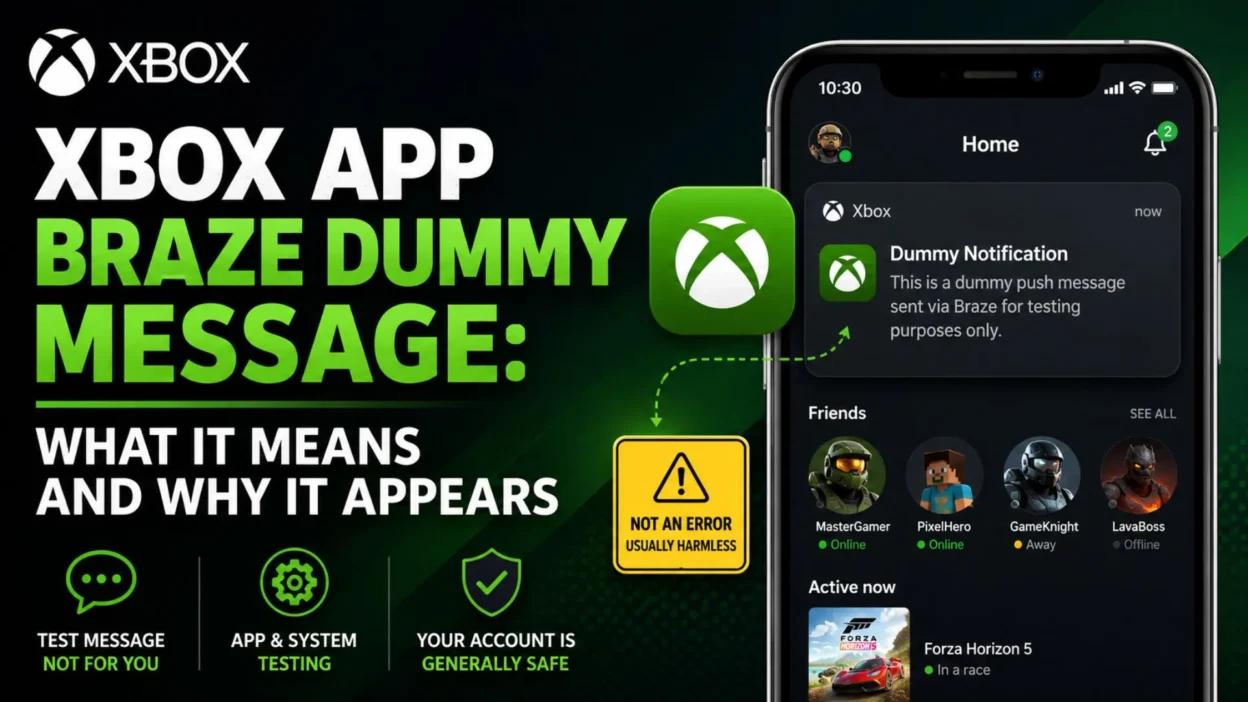
Have you ever received a notification from the Xbox app that looks strange, incomplete, or almost like a message intended for a developer rather than a regular user? You may have noticed wording such as “dummy message,” “test message,” or another unusual notification reference and wondered whether something is wrong with your Xbox account.
If you searched for “xbox app braze dummy message,” you are probably trying to understand exactly what you saw and whether you need to take action.
The good news is that a message described as a “dummy” or test message does not automatically mean your Xbox account has been hacked, compromised, or charged for something. In many cases, terminology like this is connected with testing, notification delivery, marketing campaigns, or software development. Braze is a customer engagement and messaging platform that companies can use to send communications through channels such as push notifications and in-app messages. When a company tests a campaign, placeholder content can sometimes be visible under unusual circumstances.
This guide explains what the phrase can mean, how Xbox app notifications generally work, why a test-looking notification might appear, how to distinguish a harmless notification from a genuine security concern, and what you can do if the message keeps returning.
What Is an Xbox App Braze Dummy Message?
The phrase “Xbox app Braze dummy message” combines three separate ideas: the Xbox app, Braze, and a dummy or test message.
The Xbox app is Microsoft’s application for accessing Xbox-related features and services on supported devices. Like many modern apps, it can communicate with users through notifications and other forms of messaging.
Braze is a customer engagement platform used by organizations to manage and deliver personalized communications. Depending on how a company has implemented it, a messaging platform can be involved in things such as push notifications, in-app messages, campaigns, experiments, and user engagement.
A dummy message generally means content used as a placeholder or test rather than a normal customer-facing message.
For example, a development or testing environment might use wording such as:
- “Test message”
- “Dummy notification”
- “Sample notification”
- “Testing push”
- “Placeholder”
- “This is a test”
The important point is that the word “dummy” does not, by itself, indicate malicious activity.
It can simply indicate that the message was created for testing.
However, without seeing the exact notification and knowing how the Xbox app generated it, it would be inappropriate to say that every notification containing similar wording definitely came from a specific internal Xbox testing process. The exact cause can vary depending on the app version, device, account configuration, notification system, and campaign implementation.
Why Would a Dummy Message Appear in the Xbox App?
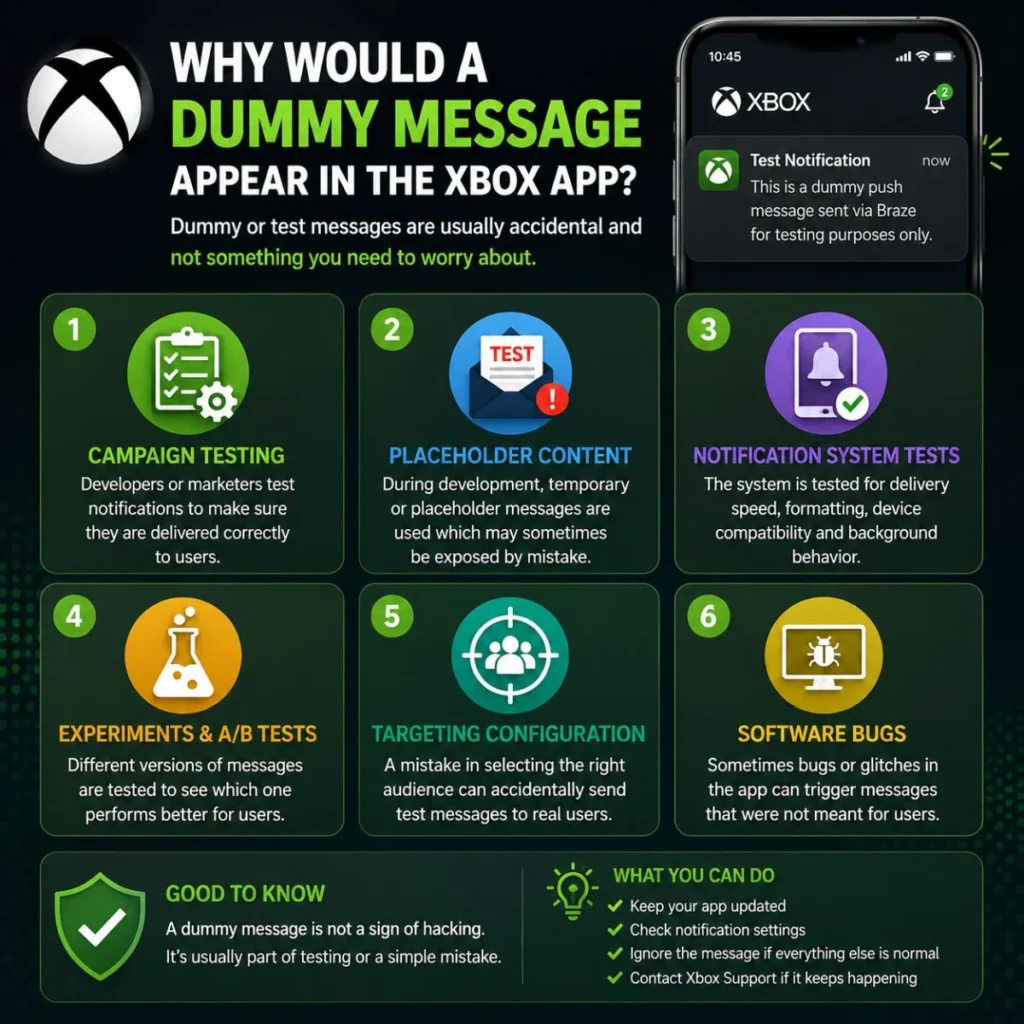
There are several possible explanations for an unusual notification.
A messaging campaign was being tested
One of the simplest explanations is that a notification campaign was being tested.
Large applications routinely need to test whether notifications are delivered correctly. A developer or marketing team may create temporary messages to verify:
- Notification delivery
- Message formatting
- Timing
- Personalization
- Device compatibility
- Deep links
- Notification behavior
- In-app display
- Campaign targeting
Ideally, users should never see internal testing content.
If test content does become visible to users, it can look confusing because the wording may not resemble a normal Xbox announcement.
A placeholder was accidentally exposed
Software systems often contain placeholder content during development.
A developer might create a campaign with a temporary title and body while testing the technical behavior. Normally, that content is replaced before the campaign reaches production.
If something goes wrong with campaign configuration, segmentation, scheduling, or deployment, an unexpected message may potentially be delivered.
That does not necessarily mean the entire application is broken. It can be an isolated configuration mistake.
A notification system was being tested
A notification can involve several components rather than one simple “send” button.
A typical process may look conceptually like this:
Application → messaging service → notification infrastructure → device → user
A company can test different parts of this process independently.
For example, the team might need to verify that a push notification reaches an Android or iOS device, opens the correct application screen, or behaves properly when the application is running in the background.
A test notification may therefore exist for technical reasons rather than because the company is trying to communicate something meaningful to the user.
An experiment or campaign configuration changed
Modern apps frequently use different versions of messages to determine which presentation performs better.
A campaign could have multiple variants, audiences, or message formats.
A configuration error could potentially expose content that was intended for testing rather than normal users.
Again, this is different from an account compromise.
Is an Xbox Braze Dummy Message a Sign of Hacking?
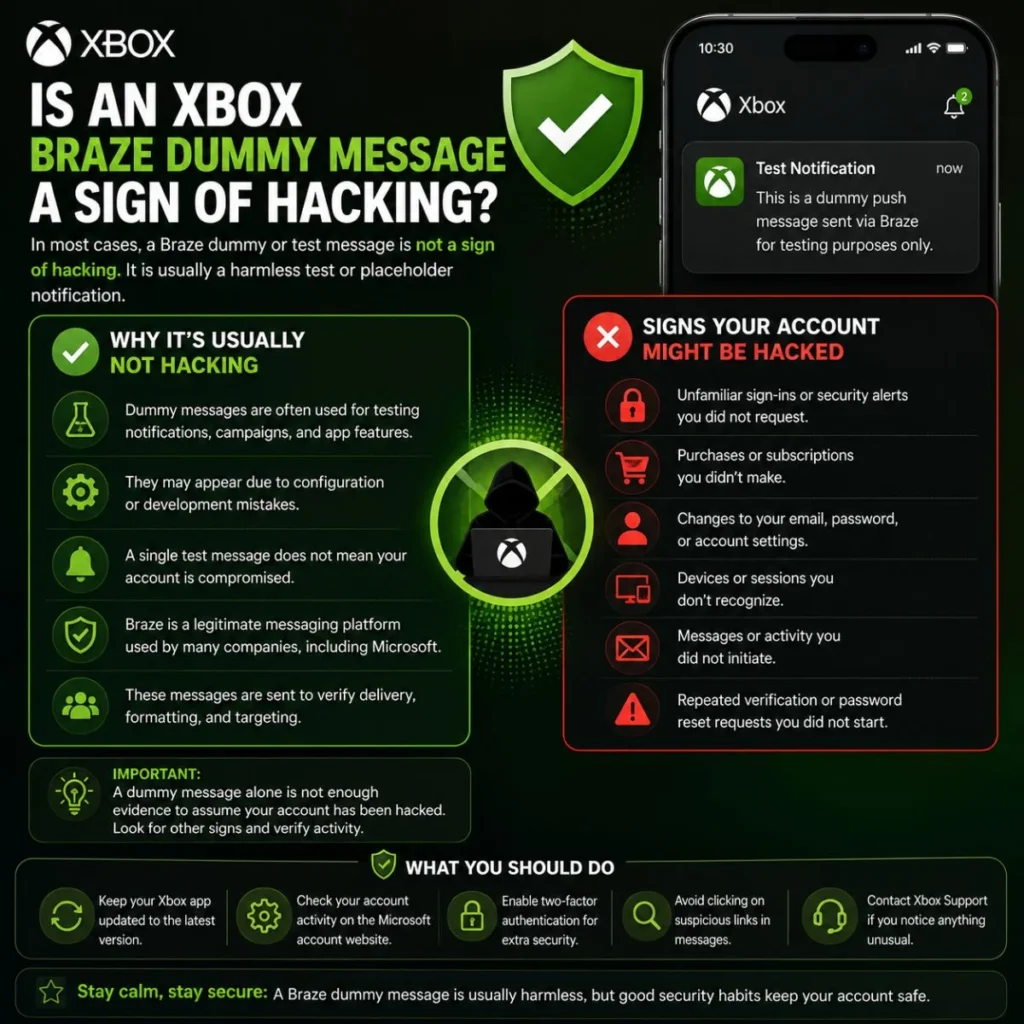
Usually, the wording alone is not enough to conclude that your account has been hacked.
Seeing an unusual notification is understandably concerning, particularly when the message contains technical terminology such as “Braze,” “dummy,” “test,” or other development-related language.
But a strange notification and an account security breach are two different things.
A genuine account-security problem would generally involve additional evidence, such as:
- An unfamiliar sign-in
- An unexpected password-change notification
- An unfamiliar security setting
- Purchases you did not make
- Changes to account information
- Messages or activity you did not initiate
- Devices or sessions you do not recognize
- Repeated authentication attempts that you did not request
If none of these things are happening and the only unusual event is a harmless-looking test notification, there is much less reason to assume that your account has been compromised.
That said, good security habits are still worthwhile.
If you receive an unexpected message and something else about your account looks suspicious, review your account security rather than relying on the notification’s wording.
What Does Braze Have to Do With the Message?
The appearance of the word Braze can be particularly confusing because many users have never heard of the platform.
Braze is a technology platform used by businesses and organizations to manage customer communications. It can support communication experiences involving push notifications, in-app messaging, email, and other channels depending on the organization’s implementation.
The presence of a Braze-related identifier does not automatically mean that Braze is your Xbox account provider or that your account has somehow been transferred to another service.
Think of it more like the infrastructure behind a communication.
When you receive a notification, you normally see the final message rather than all of the systems involved in generating and delivering it. A technical identifier becoming visible can therefore look unusual.
If a message contains an internal-looking term, it may simply reflect implementation or testing information that normally would not be visible to the end user.
What Should You Do When You Receive One?
If the message looks like a harmless test or dummy notification, you generally do not need to panic.
Start with the simplest approach.
Read the notification carefully
Look at exactly what it says.
Ask yourself:
- Does it mention a purchase?
- Does it ask you to enter a password?
- Does it request payment?
- Does it contain a suspicious link?
- Does it mention an unfamiliar account?
- Does it simply say “test,” “dummy,” or something similar?
The exact wording matters.
A message saying “dummy notification test” is very different from a message claiming that someone has changed your account password.
Avoid suspicious links
If an unexpected notification contains a link, do not automatically open it.
Instead, open the Xbox app directly through your normal method and check whether there is any related information there.
This is a useful general security practice because a legitimate-looking notification can potentially be spoofed by unrelated software or malicious actors.
Check your account if anything else looks unusual
If the notification is accompanied by unfamiliar account activity, investigate further.
Review your Microsoft account security information and look for activity you do not recognize.
If everything else appears normal, an isolated test-looking notification is less concerning.
Update the app
If the notification appears repeatedly or behaves strangely, make sure the Xbox app is updated to the latest version available for your device.
App updates can address bugs involving notifications, authentication, messaging, and background services.
Restart the app or device
A simple restart can sometimes clear temporary notification problems.
Close the application, reopen it, and see whether the behavior continues.
If necessary, restart your phone or computer as well.
How to Tell a Harmless Test Message From a Suspicious Message
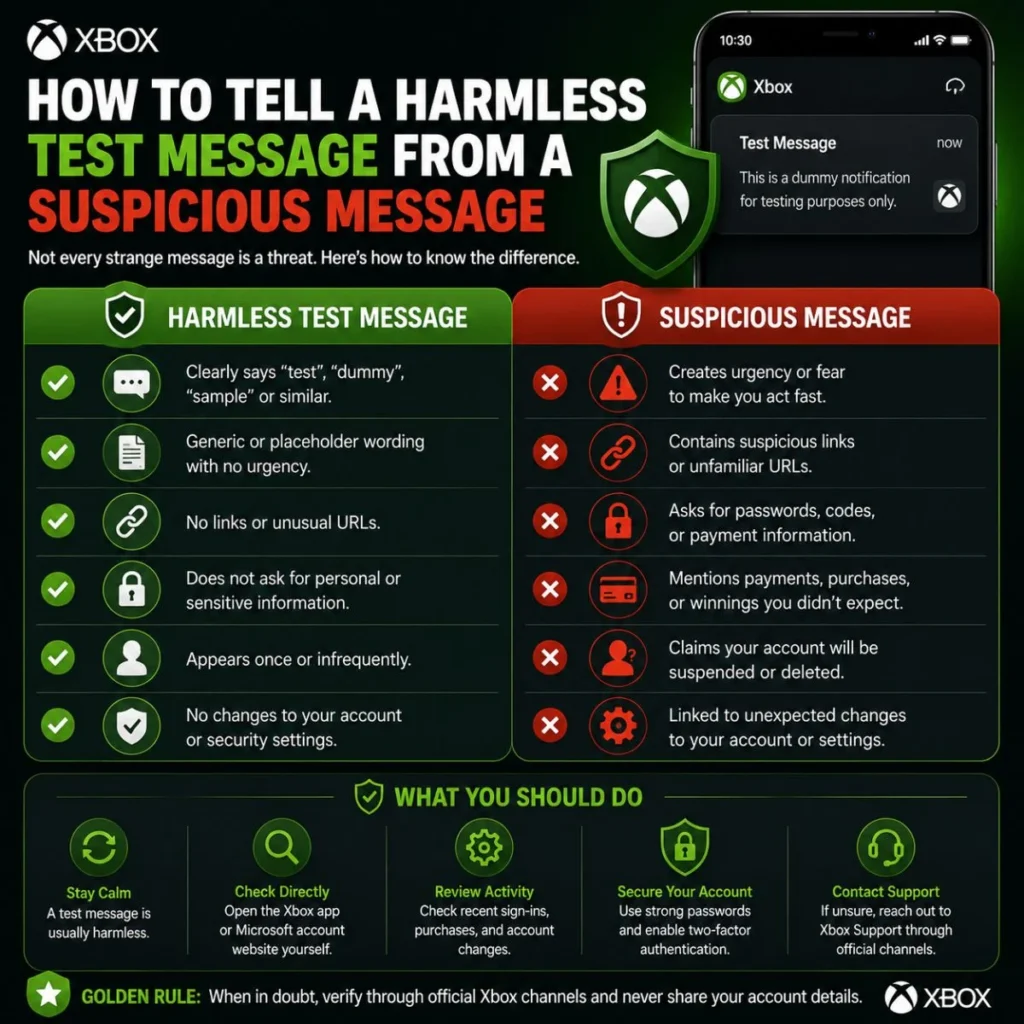
One of the most useful things you can do is look at the behavior surrounding the message, rather than focusing only on the word “dummy.”
A harmless test notification may have characteristics such as:
- Clearly says “test” or “dummy”
- Contains generic placeholder wording
- Does not request sensitive information
- Does not ask for payment
- Does not claim that your account has been compromised
- Appears only once
- Does not correspond with unusual account activity
A suspicious message may instead:
- Demand immediate action
- Ask for your password
- Request payment information
- Ask you to download an unknown application
- Use a suspicious web address
- Claim that your account will be deleted unless you act immediately
- Ask for verification codes
- Correspond with an unfamiliar account event
The distinction is important.
A technical-looking message may simply be a technical mistake. A polished-looking message can still be malicious.
Common Reasons Users Search for “Xbox App Braze Dummy Message”
People searching this phrase may actually have several different questions.
Some may have received a notification that literally contains the word “dummy.”
Others may have noticed “Braze” somewhere in an app notification and are trying to identify what it means.
Some may be wondering whether the message is connected to a recent Xbox update.
Others may simply want to know whether they should be worried.
That is why there is no single explanation that should be applied to every situation.
The most useful approach is to look at the exact notification, its timing, its source, and whether anything else unusual happened.
Short Explanations You Can Use
If you are trying to explain the situation to someone else, these are simple ways to describe it:
- A dummy message is usually a test or placeholder notification, not a normal user message.
- Seeing technical messaging terminology does not automatically mean your Xbox account has been hacked.
- If the notification contains no suspicious links or requests for sensitive information, it may simply be an accidental test notification.
- If you are concerned, check your account security separately rather than judging the account’s safety from the notification alone.
- A repeated notification may indicate a messaging or app issue that needs troubleshooting.
What If the Dummy Message Keeps Appearing?
One notification is one thing. Repeated notifications are different.
If the same test-looking message appears again and again, try troubleshooting systematically.
First, check whether the Xbox app has an available update.
Next, review your notification settings.
If the problem continues, close and restart the app.
On mobile devices, you can also review the app’s notification permissions and background behavior. The exact settings depend on whether you are using Android or iOS.
If the message is appearing at a specific time or after a particular action, make a note of that pattern.
For example:
“The notification appears every time I launch the app.”
is much more useful information than:
“The Xbox app is sending weird messages.”
If the problem persists, contacting official Xbox support with a screenshot and the exact notification wording can make troubleshooting easier.
20 Xbox App Dummy Message Examples for Understanding the Issue
These examples are illustrative examples of what test content can look like, not claims that Xbox currently uses these exact messages.
- “Test notification — please ignore.”
- “Dummy push message.”
- “This is a notification test.”
- “Sample message for testing.”
- “Push notification test successful.”
- “Test campaign message.”
- “Placeholder notification.”
- “Testing message delivery.”
- “Internal test — no action required.”
- “Sample Xbox notification.”
- “This message was sent for testing purposes.”
- “Notification delivery test.”
- “Test message: please disregard.”
- “Temporary campaign message.”
- “Sample push notification.”
- “Testing app messaging.”
- “Dummy campaign notification.”
- “Message test — no action needed.”
- “Placeholder content for notification testing.”
- “Test notification successfully delivered.”
These examples demonstrate why technical test content can look strange when it reaches a normal user.
When You Should Take the Message Seriously
Although a dummy message is not automatically dangerous, you should pay attention when the notification is connected with a real security event.
For example, suppose you receive a strange notification and then discover an unfamiliar login.
That combination deserves investigation.
Similarly, if you receive an unexpected purchase notification, password reset, security-code request, or account-change alert, do not dismiss it simply because another notification looked like a test.
The safest approach is to verify the event through the official account or application rather than using links contained in an unexpected message.
You should also be cautious if someone contacts you separately and uses the notification as a reason to request your password, authentication code, or payment information.
Legitimate support should not require you to hand over sensitive authentication credentials.
How to Personalize Your Troubleshooting
If you need help identifying exactly what happened, keep a few details available.
Write down:
- The exact text of the notification
- The device you were using
- Whether you were inside the Xbox app
- Whether the notification appeared while the app was closed
- The approximate time it appeared
- Whether it happened once or repeatedly
- Whether you clicked anything
- Whether you noticed other unusual account activity
A screenshot is particularly useful.
Do not share passwords, authentication codes, payment details, or other sensitive information when asking someone to help interpret the notification.
The message itself is usually enough.
Why Software Sometimes Shows Internal-Looking Text
Modern applications are complicated systems.
A user-facing notification may be connected to campaign IDs, templates, audience rules, localization settings, experiments, analytics events, and delivery services.
During development, engineers need to make sure all these components work together.
For example, a team might create a temporary notification and then test:
Create campaign → assign audience → send notification → receive notification → open app → track interaction
If the wrong audience is selected or a temporary campaign is accidentally activated, users could potentially encounter content that was never intended to be customer-facing.
This is one reason technical-looking notifications sometimes appear more confusing than ordinary application bugs.
The user sees a strange sentence.
Behind that sentence may be a much larger messaging system.
Should You Delete the Xbox App?
Generally, do not immediately uninstall the app simply because you received one strange notification.
Uninstalling an application can be unnecessary if the issue is actually related to a server-side campaign or notification system.
It also does not necessarily solve a problem originating outside the local application.
Try simpler troubleshooting first:
- Check for updates.
- Restart the app.
- Review notification permissions.
- Restart your device.
- Check your account for unusual activity.
- Observe whether the notification happens again.
If the problem continues, official support is a better next step than repeatedly reinstalling the application.
Should You Change Your Password?
Changing a password solely because you saw a dummy or test-looking notification is generally not necessary if there are no other signs of account compromise.
However, if you notice unfamiliar account activity, a password change can be an appropriate security step.
When changing a password, use the official Microsoft account interface rather than following a suspicious link from a notification.
Also consider using strong, unique credentials and appropriate multi-factor authentication.
The key principle is simple:
Investigate the account activity, not just the strange wording.
Is “Braze” a Virus?
No. Braze itself is not a virus.
It is a legitimate customer engagement technology platform used by organizations to communicate with users.
Seeing the name “Braze” in connection with a notification therefore does not mean that your phone or computer has been infected.
The more relevant question is why a particular message or technical identifier became visible to you.
If you are concerned about malware, look for broader signs such as unexpected applications, unusual device behavior, suspicious permissions, or other security warnings rather than treating the presence of the word “Braze” as proof of infection.
Does a Dummy Message Affect Your Xbox Account?
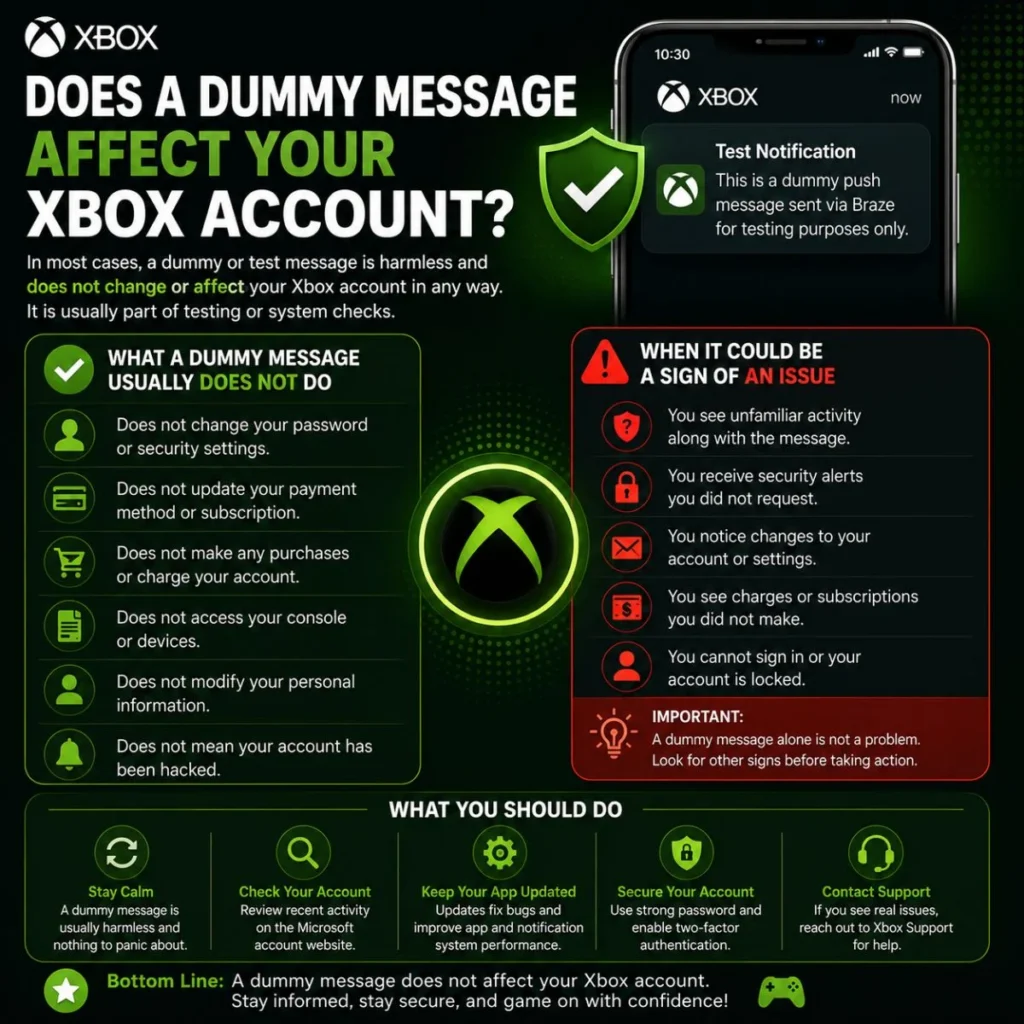
A test notification by itself normally does not imply that anything has changed about your account.
A notification can simply be communication.
It does not necessarily mean:
- Your account was modified
- Your subscription changed
- Your payment method changed
- Your console was accessed
- Your password was changed
- Your personal information was exposed
Those events require separate evidence.
If the notification contains no meaningful account action and everything else looks normal, there may be nothing you need to do.
Frequently Asked Questions
What does an Xbox app Braze dummy message mean?
It generally refers to a test, placeholder, or sample-style notification associated with a messaging system. The wording alone does not establish that the message is malicious or that an account has been compromised.
Is Braze connected to Xbox notifications?
Braze is a customer engagement and messaging platform. If the term appears in connection with an Xbox-related notification, it may indicate that messaging infrastructure or campaign technology is involved. The exact implementation behind a particular Xbox notification cannot be confirmed from the phrase alone.
Is an Xbox dummy message a sign that my account was hacked?
Not by itself. A test-looking notification is not sufficient evidence of a compromised account. Look for additional signs such as unfamiliar logins, purchases, password changes, or other account activity you did not initiate.
Should I click a link in a strange Xbox notification?
If the notification is unexpected and contains a link, it is safer not to click it immediately. Open the official Xbox or Microsoft service directly and verify whether the claimed event exists.
Why would a test notification reach normal users?
Possible explanations include campaign testing, configuration mistakes, placeholder content, software bugs, or notification-system testing. The exact reason depends on the implementation and circumstances.
What should I do if the message keeps appearing?
Update the Xbox app, review notification permissions, restart the application and device, and observe whether the notification continues. If it persists, contact official Xbox support and provide the exact message and a screenshot without exposing sensitive account information.
Final Thoughts on the Xbox App Braze Dummy Message
If you searched for “xbox app braze dummy message” because you received something strange, the most important thing to remember is not to jump straight to the worst-case explanation.
Words such as “dummy,” “test,” or technical references such as “Braze” can be associated with software messaging and campaign infrastructure. A notification that looks like an internal test does not automatically mean your account has been hacked or that your device has a virus.
At the same time, it is smart to remain cautious. Look at the exact wording, avoid suspicious links, and check your account independently if the notification mentions a security event, purchase, password change, or other action you do not recognize.
If it happened once and nothing else seems unusual, it may simply have been an accidental test or placeholder notification.
If it keeps happening, document the behavior and troubleshoot the application rather than guessing about the cause.
Most importantly, judge the situation based on evidence and account activity, not merely on one unfamiliar technical term. A strange notification can be confusing, but understanding how modern messaging systems work makes the situation much easier to put into perspective.
If you have the exact text of the notification, comparing that wording with the context in which it appeared is the best way to determine what it most likely means.

Muhammad Sarfraz is a content creator and author at Message Ideas Daily, passionate about creating heartfelt, practical, and meaningful message ideas that help people express their feelings and connect with others.