Have you ever opened a message and wondered why it looked like a strange mix of letters, numbers, and symbols? Maybe you saw a long string of characters that made no sense at all. In some cases, that information may be an encrypted message.
Encryption helps protect digital information from people who should not have access to it. Many apps and online services use encryption when people send private messages, share files, make payments, or access personal accounts. Often, the process happens in the background, so users never see the protected version of their messages.
Still, encryption can seem confusing at first. An encrypted message is not simply a secret sentence with random letters added to it. Modern encryption uses mathematical methods, algorithms, and cryptographic keys to protect information.
This guide explains what an encrypted message means, how message encryption works, what encrypted text may look like, and how encryption differs from encoding and hashing. You will also find simple examples of coded messages, ideas for friends and couples, and practical tips for keeping private conversations safer.
What Is an Encrypted Message?
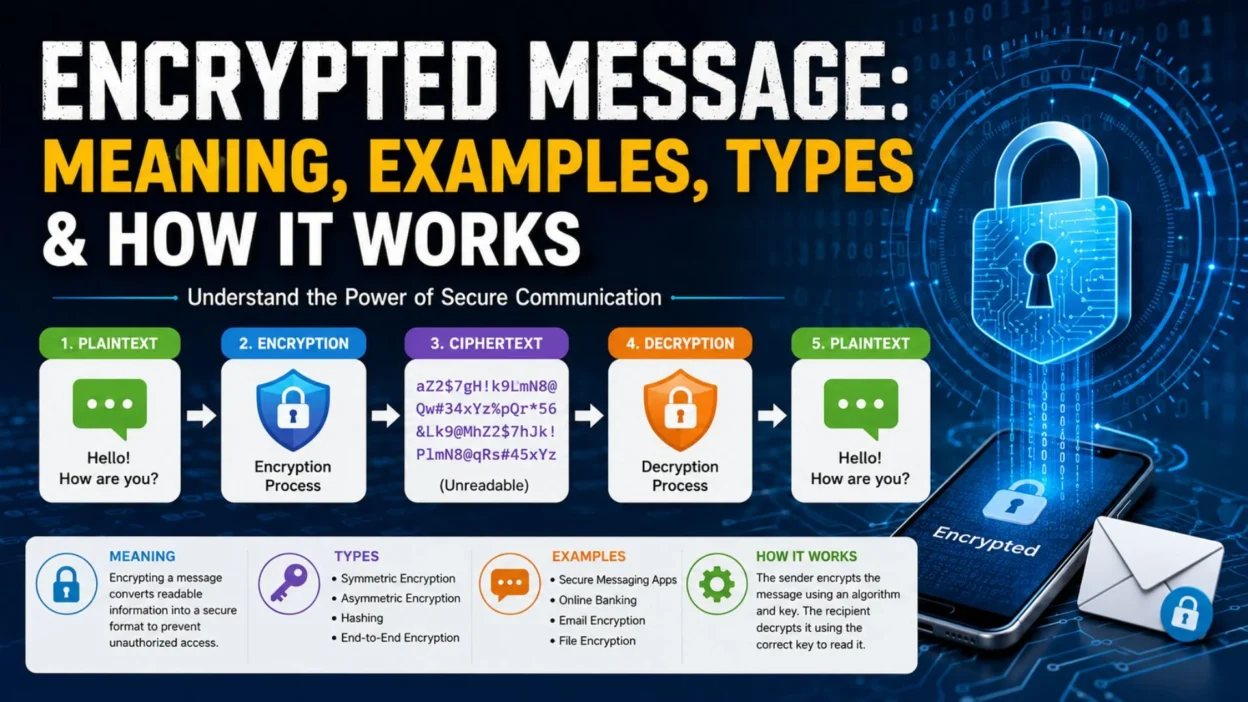
An encrypted message is a readable message that a cryptographic system changes into protected information. The original message is called plaintext, while the transformed version is called ciphertext.
Think of encryption as putting a message inside a special digital lock. The sender starts with readable information. Next, the encryption system transforms that information into a protected form. Finally, the intended recipient uses the correct cryptographic process to recover the original content.
The basic process looks like this:
Plaintext → Encryption → Ciphertext → Decryption → Plaintext
For example, imagine sending:
“I’ll call you after work.”
A secure messaging system may turn that message into protected data before sending it across the network. The recipient’s device then processes the encrypted data and displays the original sentence.
Most modern apps handle these steps automatically. Therefore, you usually do not need to understand the mathematics behind encryption to use it.
Why Do People Encrypt Messages?
People encrypt messages mainly to protect private information.
For instance, a conversation may contain personal details, business plans, financial information, photographs, or other content that should not fall into the wrong hands.
Encryption can help protect:
- Personal conversations
- Private photos and videos
- Financial information
- Business discussions
- Confidential documents
- Personal details
- Account-related information
- Sensitive work communication
However, encryption does not solve every security problem. Someone who gains access to an unlocked phone, compromised account, or shared screenshot may still see the conversation.
That is why encryption works best as part of a wider approach to digital security.
How Does Message Encryption Work?
The mathematics behind modern cryptography can become very complex. Fortunately, you can understand the basic idea without studying advanced mathematics.
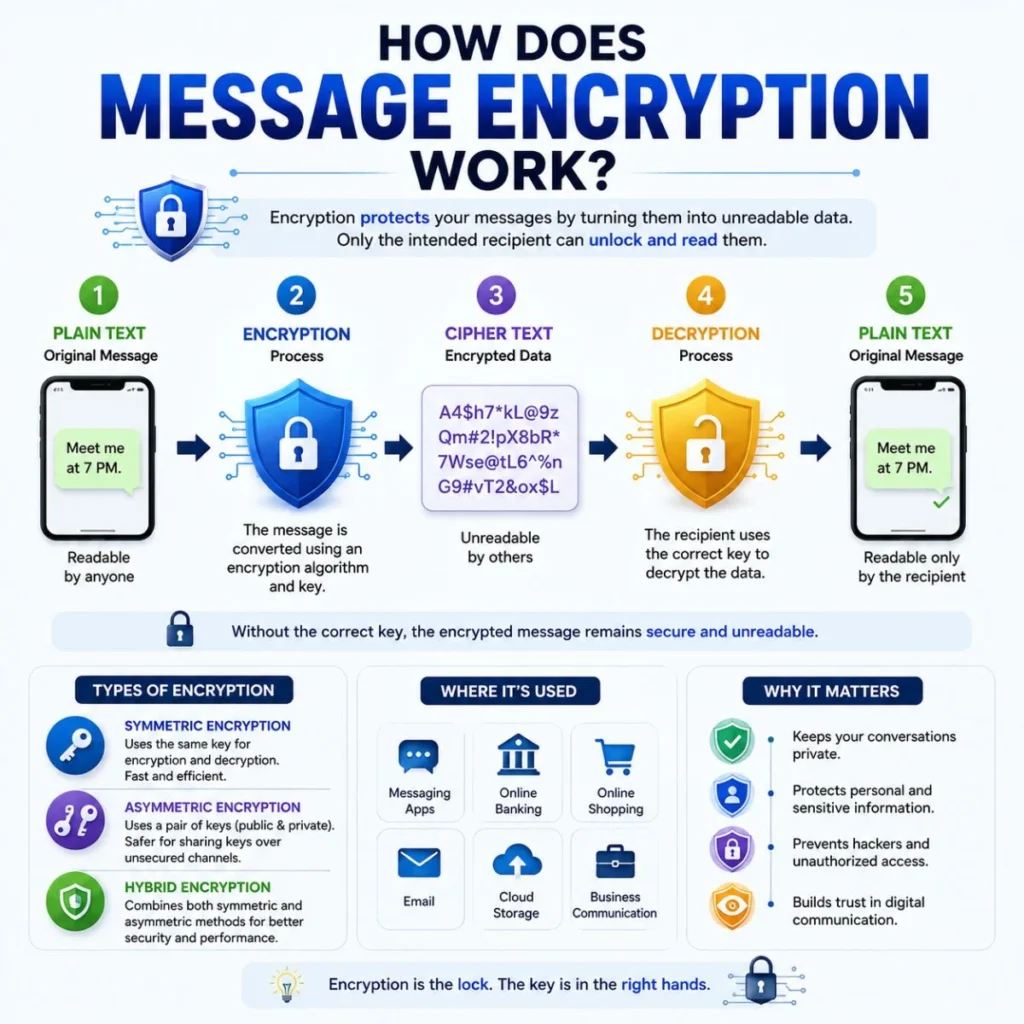
Imagine that Sarah wants to send a private message to John.
Sarah types her message on her phone. The messaging system then uses a cryptographic algorithm and key to transform the readable text into protected data. The system sends that protected information to John’s device.
John’s device receives the data and uses the appropriate cryptographic process to recover the original message.
As a result, Sarah can write a normal sentence while the technology handles the complicated security work in the background.
Plaintext
Plaintext means the original readable information.
For example:
“Are you coming to dinner tonight?”
Anyone who can see the plaintext can read the message directly.
Ciphertext
Ciphertext refers to the protected output created by an encryption process.
Depending on the system, it may appear as random-looking characters, numbers, symbols, or computer data. Some systems may not display the ciphertext to users at all.
Encryption Key
A cryptographic key helps control the encryption and decryption process.
Different systems use keys in different ways. For that reason, secure key generation, storage, exchange, and management all play an important role in encryption.
Decryption
Decryption reverses the encryption process in an authorized way.
When the recipient opens a protected message, their device or application can use the required cryptographic information to recover the original text.
What Does an Encrypted Message Look Like?
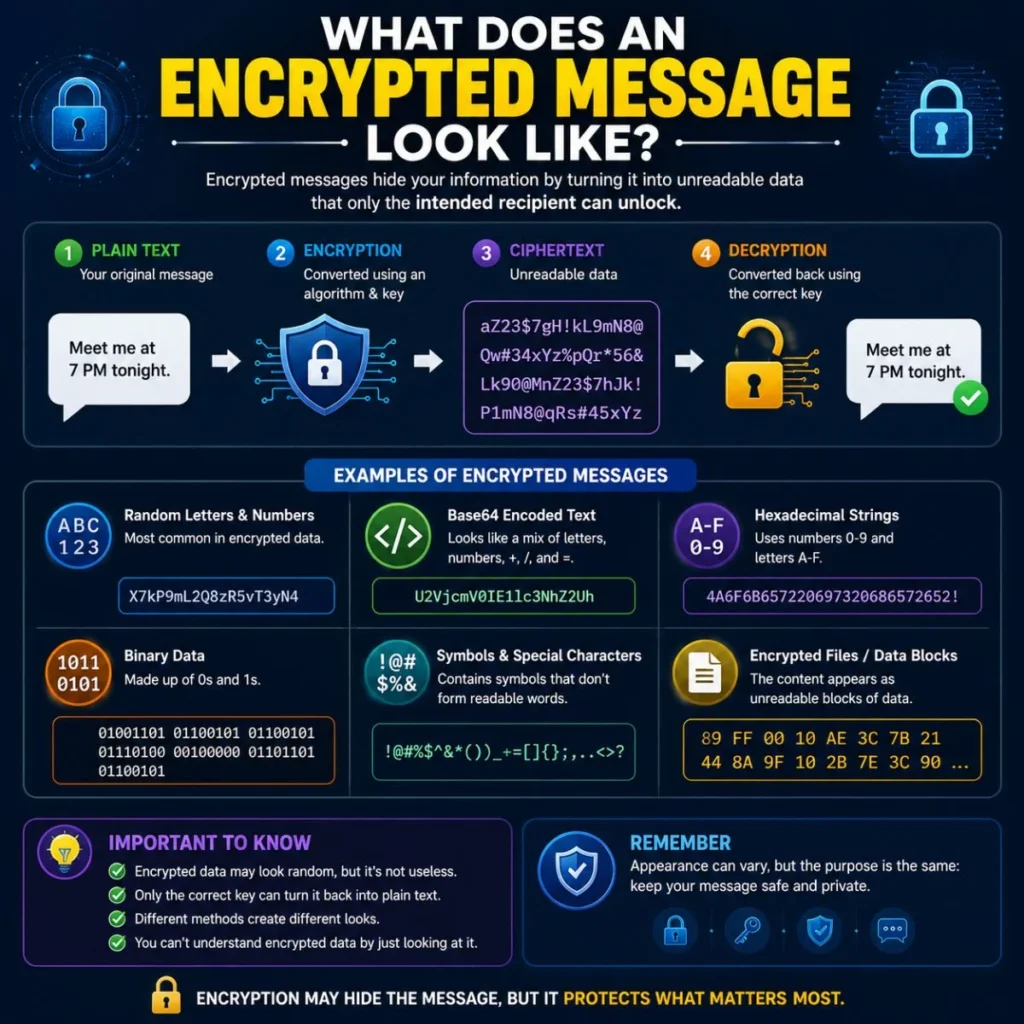
There is no single format for an encrypted message.
Depending on the system, protected information may appear as:
- A long string of letters
- Numbers and symbols
- Hexadecimal characters
- Computer-readable data
- Binary-looking information
- An unreadable file
- A string of mixed characters
For example, fictional encrypted-looking text might appear like this:
8F3A92C1D74B6E91…
Another example could look like:
X7K-29Q-P4M-81Z
However, you should not assume that every strange-looking string contains encrypted information.
A random-looking string could represent encoded data, a hash, a computer-generated identifier, compressed information, or even a simple homemade code.
Therefore, appearance alone cannot tell you whether something uses real encryption.
Encryption vs. Encoding vs. Hashing
Many people use the words encryption, encoding, and hashing interchangeably. However, these technologies serve different purposes.
Understanding the difference can help you identify what you are actually looking at.
What Is Encryption?
Encryption protects information from unauthorized access.
A cryptographic system uses an algorithm and key to transform readable data into protected information. An authorized party can then recover the original data through the correct decryption process.
The main goal is confidentiality.
What Is Encoding?
Encoding changes information from one format into another.
For example, Base64 can represent binary data as text characters. Developers often use encoding to make data easier to transmit or store.
However, encoding does not normally provide privacy. Someone who knows the encoding method can decode the information without needing a secret key.
What Is Hashing?
Hashing takes information and produces a fixed-length output called a hash.
Cryptographic hashes help with tasks such as checking data integrity and supporting secure password systems.
Unlike normal encryption, hashing does not aim to provide a simple process for recovering the original message.
In short:
Encryption protects information.
Encoding changes the format of information.
Hashing creates a fixed output from information.
These differences matter when you try to understand a mysterious string or a security feature.
What Is End-to-End Encryption?
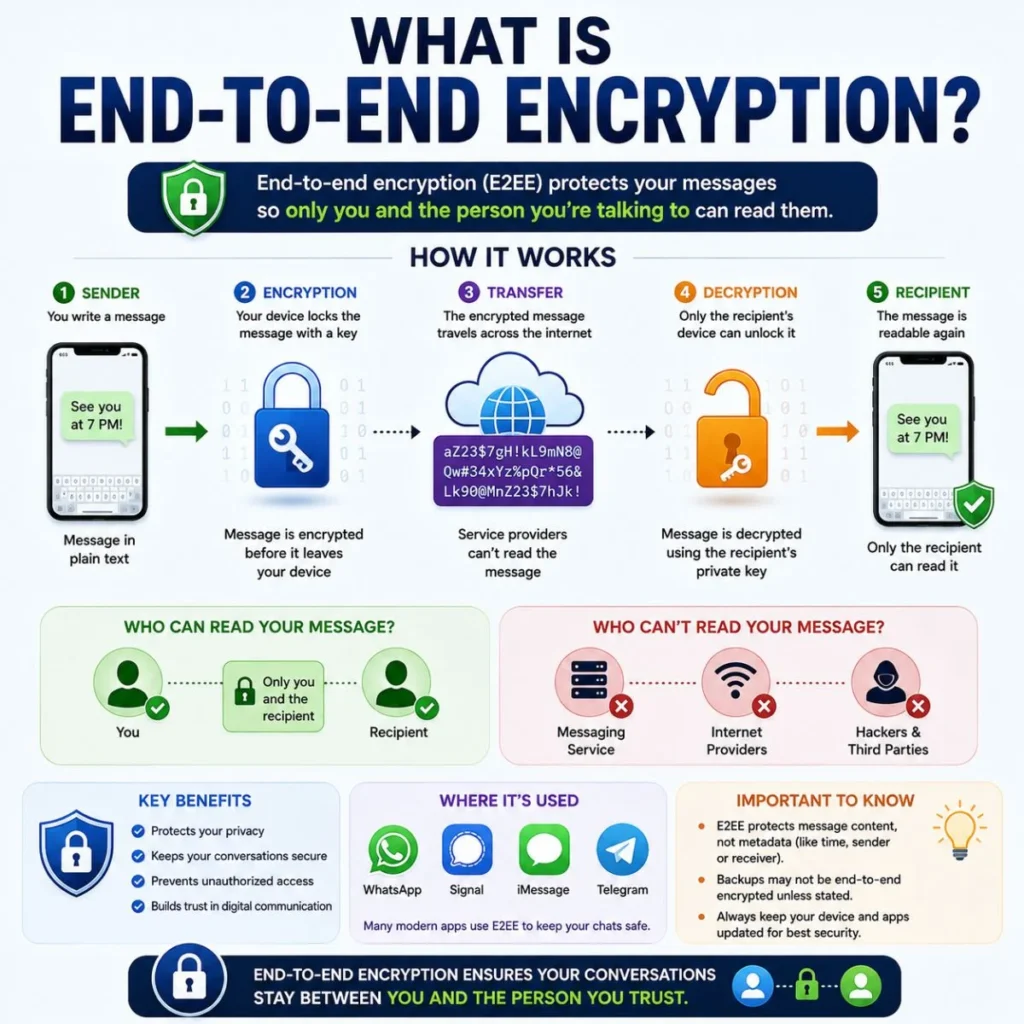
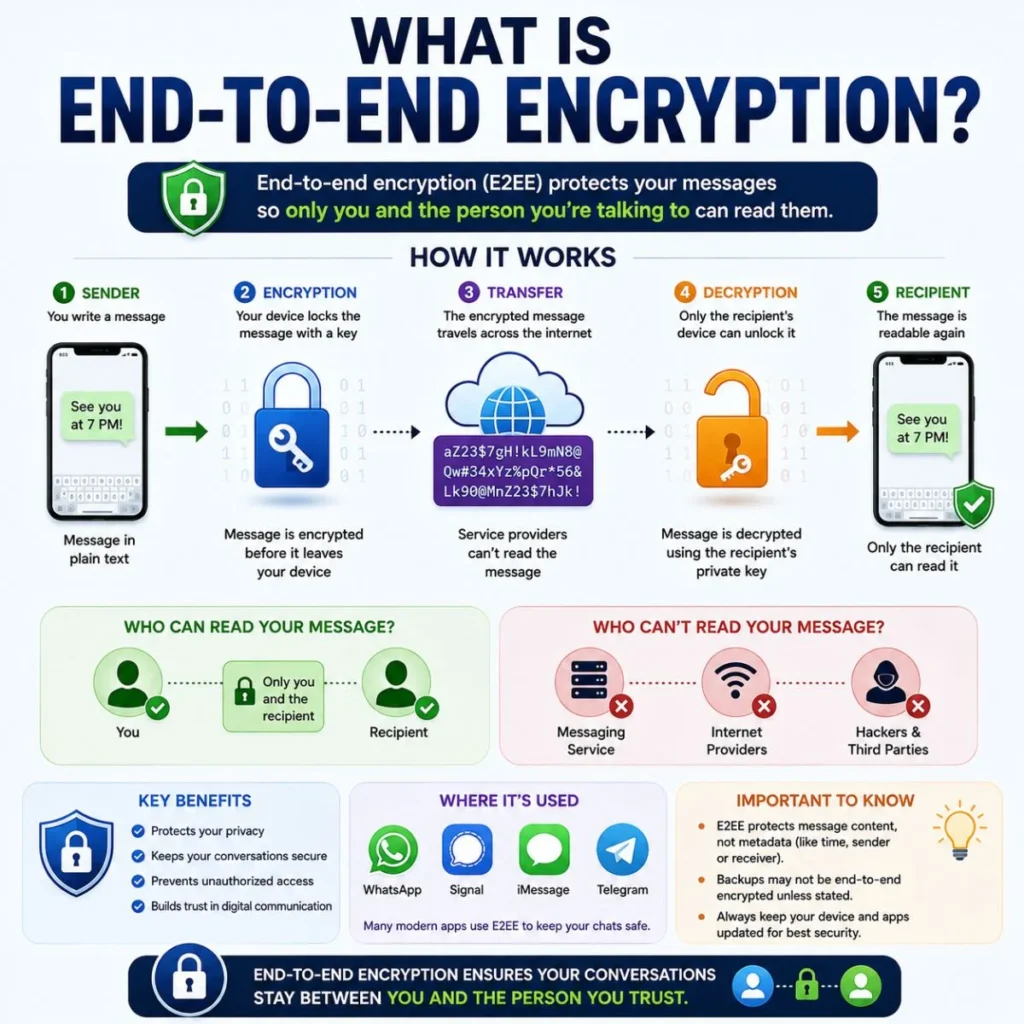
You have probably heard the phrase end-to-end encryption, especially when discussing private messaging.
End-to-end encryption, or E2EE, aims to protect message content from the sender’s device to the recipient’s device. The system encrypts the content at one endpoint and allows the intended endpoint to decrypt it.
A simplified example looks like this:
Your phone → encrypted data → communication service → encrypted data → recipient’s phone
The communication service can transport the protected information without necessarily having access to the readable message content.
Why Does End-to-End Encryption Matter?
End-to-end encryption adds an important layer of privacy.
For example, if someone intercepts protected data while it travels across a network, that person should not simply see the original conversation.
Still, E2EE does not make every part of a communication completely private.
A service may handle other information, such as account details, device information, timestamps, or other metadata. Backups can also have their own security settings.
Therefore, anyone who cares about privacy should look at the complete security design rather than focusing on one label.
Common Types of Message Encryption
Different situations require different cryptographic methods. Three important concepts are symmetric encryption, asymmetric cryptography, and hybrid systems.
Symmetric Encryption
Symmetric encryption uses a secret key to protect and recover information.
The system uses the same secret key, or a closely related secret-key process, during encryption and decryption.
This approach works efficiently with large amounts of data. However, both sides need a secure way to manage the secret key.
If an attacker obtains the relevant key, the protection may fail.
Asymmetric Encryption
Asymmetric cryptography uses two related keys.
One key is generally public, while the other remains private.
The public key can be shared with others. In contrast, the private key requires strong protection.
This approach can support secure communication, authentication, and the creation of shared secrets.
Hybrid Encryption
Modern systems often combine different cryptographic techniques.
For example, asymmetric cryptography can help establish a secure session key. The system can then use symmetric encryption to protect the actual message data efficiently.
This combination offers useful advantages in practical communication systems.
Why Do Messaging Apps Use Encryption?
Messaging apps can use encryption to protect conversations while they move between devices.
Without suitable security measures, someone who intercepts network traffic could potentially obtain information from that traffic.
Encryption changes the readable content into protected data. As a result, an unauthorized person cannot simply read the captured information.
Modern messaging security often involves more than encryption alone. Authentication, key exchange, integrity checks, device verification, and other security features can also play important roles.
For this reason, users should look beyond a simple “encrypted” label when comparing messaging services.
You may want to check whether a service provides:
- End-to-end encryption
- Secure backups
- Device verification
- Strong account protection
- Clear security documentation
- Good key-management practices
- Privacy controls
Everyday Examples of Encrypted Messages
You probably use encryption more often than you realize.
Private Chats
When you send a message through a service that supports encryption, the application may protect the content automatically.
You could type:
“I’ll meet you at 8.”
The app handles the technical security process without requiring you to manually encrypt anything.
Online Banking
Banks and financial services use cryptographic protections to help secure information exchanged between customers and their systems.
This protection can cover sensitive information during digital transactions.
Online Shopping
Secure shopping websites use encryption to help protect information exchanged between your browser and the website.
That protection becomes especially important when you enter account or payment-related information.
Business Communication
Companies often need to protect confidential information. Encryption can help secure business conversations, documents, and other digital data.
File Sharing
Encryption can protect files as people store or transfer them.
Therefore, encryption applies to much more than text messages.
Encrypted Message Examples
Some people search for encrypted message examples because they want messages that look mysterious, secret, or coded.
The examples below are creative coded messages. They are not examples of secure modern encryption.
- X7-21: Thinking about you.
- CODE 143: You already know what this means.
- M-17: See you when the stars come out.
- Q9-LOVE: You’re still my favorite person.
- A4-B8-C2: Keep this between us.
- SECRET 01: I have something to tell you.
- N7X: Missing you more than expected.
- 143-22: You mean more than you know.
- BLUE-9: Meet me at our usual place.
- R4-HEART: Sending you a little love.
- MSG-07: Don’t forget our plan.
- K2-NIGHT: Sleep well, beautiful.
- P-88: Your smile made my day.
- Z9-XO: Consider this your secret reminder.
- M-404: I can’t stop thinking about you.
- C7-11: You’re my favorite notification.
- T9-LOVE: Distance doesn’t change what matters.
- HIDDEN-21: Some feelings are easier to code.
- R-143: You are always on my mind.
- NIGHT-7: Sweet dreams, secret keeper.
- S4-22: I’ll see you soon.
- CODE-LOVE: No decoder required—you know.
- X1-HEART: Keep smiling for me.
- PRIVATE-9: This message is just for you.
- END-01: Until our next conversation.
These examples can work well for playful texts, captions, inside jokes, or creative posts.
For genuine privacy, though, use an established encryption system instead of a homemade code.
Encrypted Messages for Friends
A secret-looking message can make an ordinary conversation more fun.
You can create a private message around an inside joke, a shared memory, or a funny situation. That personal connection often makes the message more enjoyable than a complicated code.
Here are some ideas:
- “Top secret: you’re still my favorite troublemaker.”
- “Mission update: snacks first, everything else later.”
- “If you decoded this, you owe me coffee.”
- “Classified information: our friendship is still undefeated.”
- “Access granted. Best-friend privileges remain active.”
- “Secret report: I already know what you’re going to say.”
- “Confidential reminder: don’t forget our plan.”
- “Code unlocked: you’re officially invited.”
- “Encrypted because normal messages were too boring.”
- “Breaking news: you’re still stuck with me.”
- “Mission status: friendship successfully maintained.”
- “Secret transmission: I found something you’ll love.”
- “Password accepted. Now tell me the gossip.”
- “This message will self-destruct after you buy the snacks.”
- “Classified friendship update: I miss hanging out with you.”
For actual private information, choose a secure messaging system rather than relying on these playful codes.
Encrypted Messages for Couples
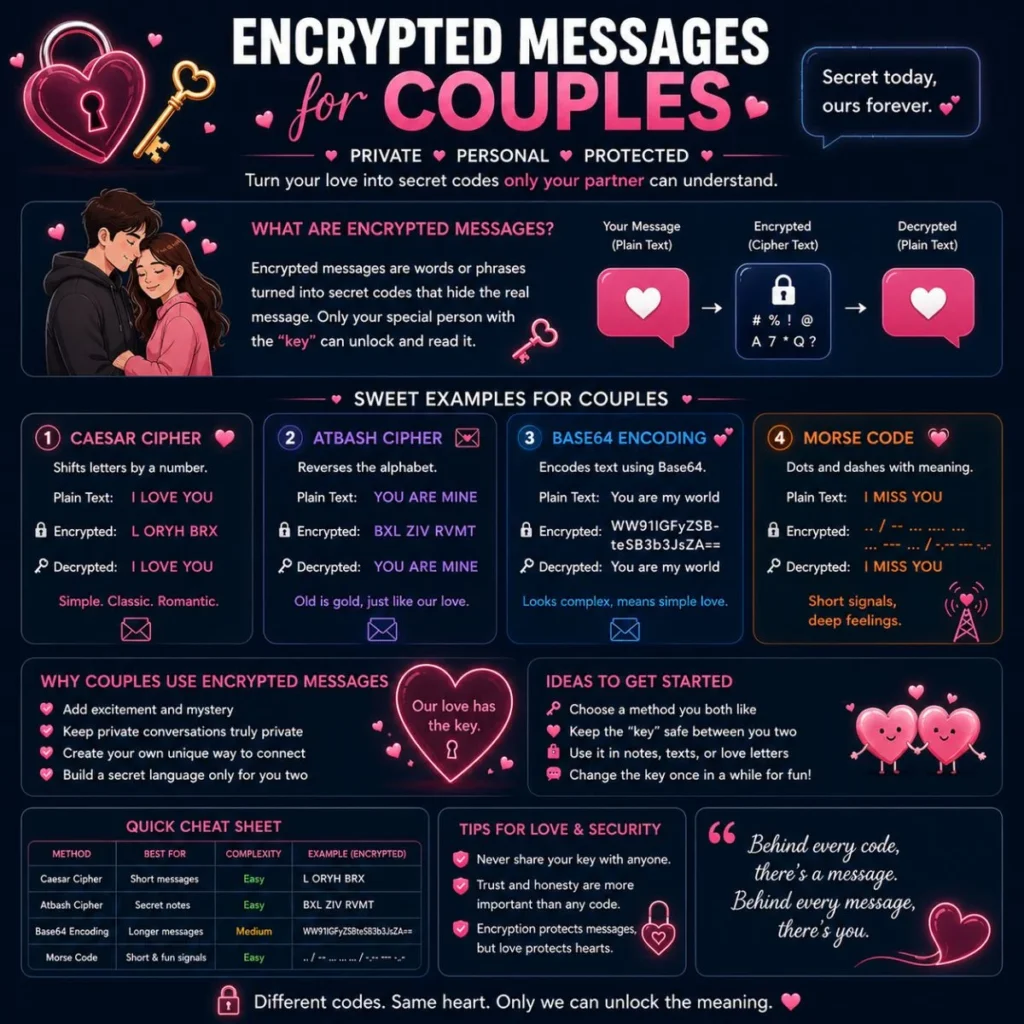
Couples often create private phrases that carry a special meaning.
A short coded message can feel romantic because only the two people understand the reference.
Try these:
- “Secret transmission: I miss you.”
- “Code unlocked: I want to see you tonight.”
- “Private message: You’re still the first person I want to tell.”
- “Encrypted feeling: I wish you were here.”
- “Access granted to my heart.”
- “Hidden in plain sight: I love you.”
- “Translation required: Come closer.”
- “Confidential: You’re the best part of my day.”
- “Message secured: You make everything feel better.”
- “No decoder needed. You already know.”
- “Private code: I can’t wait to see you.”
- “Secret reminder: You’re always on my mind.”
- “Transmission complete: Sending you all my love.”
- “Classified information: I smiled when I saw your name.”
- “Code word unlocked: Forever sounds good with you.”
These messages are meant for fun and romance. They do not provide real cryptographic security.
How to Create Your Own Coded Message
Creating a playful secret message doesn’t require advanced technology.
Instead, choose something meaningful to you and the person receiving the message.
Use Numbers
Numbers can represent a date, word, or shared memory.
For example, you could use an important date as a private reference.
Use Initials
Take the first letters of a sentence that means something to both of you.
For example:
“Meet Me After Dinner”
could become:
MMAD
A friend who knows the phrase may understand it immediately.
Use an Inside Joke
An inside joke can work as a natural secret code.
A single word might remind your friend of an entire funny story.
Use a Shared Location
A favorite restaurant, city, classroom, beach, or travel destination can become part of your private shorthand.
Create a Special Phrase
You can agree that a particular phrase means something else.
For example, “Did you check the weather?” could secretly mean:
“Do you want to leave?”
The best personal codes are usually easy to remember and meaningful to the people using them.
How to Keep Real Messages More Secure
If your message contains sensitive information, avoid homemade encryption methods.
Instead, use trusted security tools and follow good digital habits.
Choose a Secure Messaging Service
Look for services that clearly explain how they protect messages and manage encryption.
Protect Your Phone
Set a strong device passcode and keep your operating system updated.
Secure Your Account
Use a unique password and turn on multi-factor authentication when the service offers it.
Check Backup Settings
Some messaging services handle backups differently from live conversations. Therefore, review your backup settings if you regularly send sensitive information.
Verify Important Contacts
For highly sensitive conversations, use available identity or security verification features when appropriate.
Avoid Suspicious Links
Even strong encryption cannot protect you if you willingly provide your password or personal information to a scammer.
Good digital security requires both strong technology and careful decisions.
Can You Decode an Encrypted Message?
Sometimes you can decode a message, but the answer depends on how the message was created.
A simple homemade code may be easy to solve once you understand the pattern.
Likewise, an encoded message can often be decoded after identifying the encoding method.
Modern encryption works differently. Strong cryptographic systems aim to prevent unauthorized people from recovering the original information without the necessary keys.
Therefore, you should not assume that every long string of characters can be decoded with a simple online tool.
A strange string might actually be:
- Encrypted information
- Encoded text
- A hash
- Compressed data
- A digital signature
- A random identifier
- A session token
- A homemade code
Without knowing its source, you cannot reliably identify it from appearance alone.
Is an Encrypted Message Completely Safe?
Encryption can provide strong protection, but it cannot remove every digital-security risk.
Consider a simple example. Your messaging service may protect a conversation while it travels across the internet. However, another person could still read that conversation if they gain access to your unlocked phone.
Similarly, an attacker who takes control of your account may access information through the account itself rather than intercepting the encrypted communication.
Other risks include:
- Phishing attacks
- Malware
- Weak passwords
- Account theft
- Unsecured devices
- Screenshots
- Unsafe backups
- Information shared by recipients
Therefore, encryption should form one layer of a broader security strategy.
When Should You Use Encrypted Messages?
Encryption becomes especially useful when a conversation contains information that you would not want strangers or unauthorized people to read.
For example, you may want stronger privacy when discussing:
- Personal matters
- Financial information
- Business plans
- Confidential documents
- Private photographs
- Sensitive professional information
- Account-related details
- Personal identification information
For an ordinary message such as:
“What time are you coming?”
the content may not seem sensitive. Even so, the messaging app may still encrypt it automatically.
The important factor is understanding what your communication service protects and how it handles your information.
Common Misunderstandings About Encrypted Messages
“Encryption means nobody can ever see the message.”
Not necessarily.
Encryption protects information during specific parts of the communication process. It cannot stop someone from viewing content on an unlocked device or through a compromised account.
“Anything that looks random must be encrypted.”
That’s incorrect.
Random-looking data can represent many different things, including encoded information, hashes, identifiers, and generated tokens.
“A secret code is the same as encryption.”
A private code can hide a message from a casual observer, but it does not automatically provide strong security.
“Encryption makes you anonymous.”
Encryption and anonymity serve different purposes.
Encryption can protect message content while a service still handles account information or other metadata.
“Longer ciphertext always means stronger security.”
Length alone does not determine security.
The encryption algorithm, key management, implementation, and overall system design matter much more.
How to Choose the Right Secret Message
Your goal should determine the type of message you use.
If you want real privacy, choose a trusted communication service that uses strong security practices.
If you want a fun coded message, create a private reference using an inside joke, number, or shared phrase.
For a romantic message, use a code that has emotional meaning for you and your partner.
For a social media post, a short mysterious phrase can create curiosity without pretending to offer real encryption.
In other words, don’t confuse a message that looks secret with a message that is actually secure.
A simple sentence can have strong cryptographic protection, while a complicated string of symbols may offer none.
FAQ About Encrypted Messages
What does an encrypted message mean?
An encrypted message contains information that a cryptographic system has transformed into protected data. The authorized recipient or device can use the required cryptographic process to recover the original content.
What does an encrypted message look like?
There is no standard appearance. Some encrypted data may contain random-looking characters, numbers, or symbols. However, many modern messaging apps hide the encrypted form from users completely.
Can I create an encrypted message myself?
You can create a fun coded message yourself, but creating secure modern encryption requires much more than replacing letters with numbers or symbols. For real privacy, use established cryptographic technology.
Is an encrypted message safe?
Encryption can provide strong protection against unauthorized access to message content. Nevertheless, device security, account protection, backups, malware, and user behavior can still create risks.
What is the difference between an encrypted and coded message?
An encrypted message uses cryptographic techniques designed to protect information. A coded message usually uses a private system or shared meaning. A simple code does not provide the same security as modern encryption.
Can every encrypted message be decoded?
No. Strong modern encryption aims to prevent unauthorized decryption without the necessary cryptographic keys. A simple code or encoding scheme may be much easier to decode.
Conclusion
An encrypted message protects readable information by transforming it through a cryptographic process. Although people sometimes picture encryption as a strange string of random characters, modern messaging apps often handle the process quietly in the background.
The distinction between encryption, encoding, hashing, and simple secret codes also matters. Encryption aims to protect information, encoding changes its format, and hashing creates a fixed output from data. Meanwhile, a homemade code can create a fun private language between friends or couples, but it should not replace proper security technology.
If you simply want to send a mysterious message, use an inside joke, meaningful number, shared phrase, or personal reference. On the other hand, sensitive information deserves a stronger approach. Choose a trusted messaging service, protect your accounts, keep your devices updated, and pay attention to backup and privacy settings.
Most importantly, remember this simple rule:
A message does not have to look secret to be secure, and a message that looks secret is not necessarily secure.
Once you understand that difference, the idea of an encrypted message becomes much easier to understand—and you can choose the right kind of message for both fun conversations and genuine privacy.

Muhammad Sarfraz is a content creator and author at Message Ideas Daily, passionate about creating heartfelt, practical, and meaningful message ideas that help people express their feelings and connect with others.