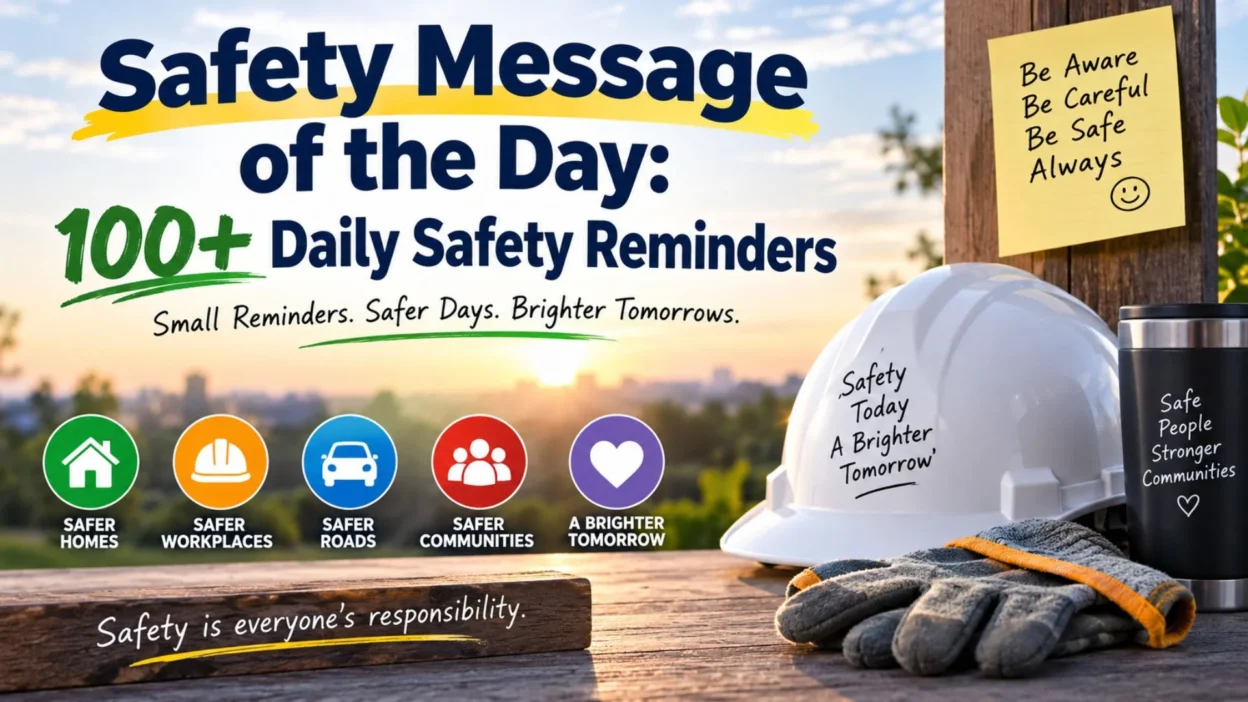
Some safety reminders take only a few seconds to read, but they can stay with you for the rest of the day. A quick reminder to slow down, check your surroundings, wear protective equipment, stay focused while driving, or think before acting can make ordinary moments safer.
A safety message of the day is a simple way to keep safety visible without turning every reminder into a long lecture. It can be used at the start of a work shift, shared in a team chat, posted on a notice board, sent to students, added to a workplace briefing, or shared with family and friends.
The best safety messages are short enough to remember and practical enough to use immediately. Below, you’ll find daily safety reminders covering work, home, driving, travel, personal awareness, health, and more. Some are serious, some are encouraging, and a few are lighthearted—but each is designed to encourage safer choices.
Top Safety Messages of the Day
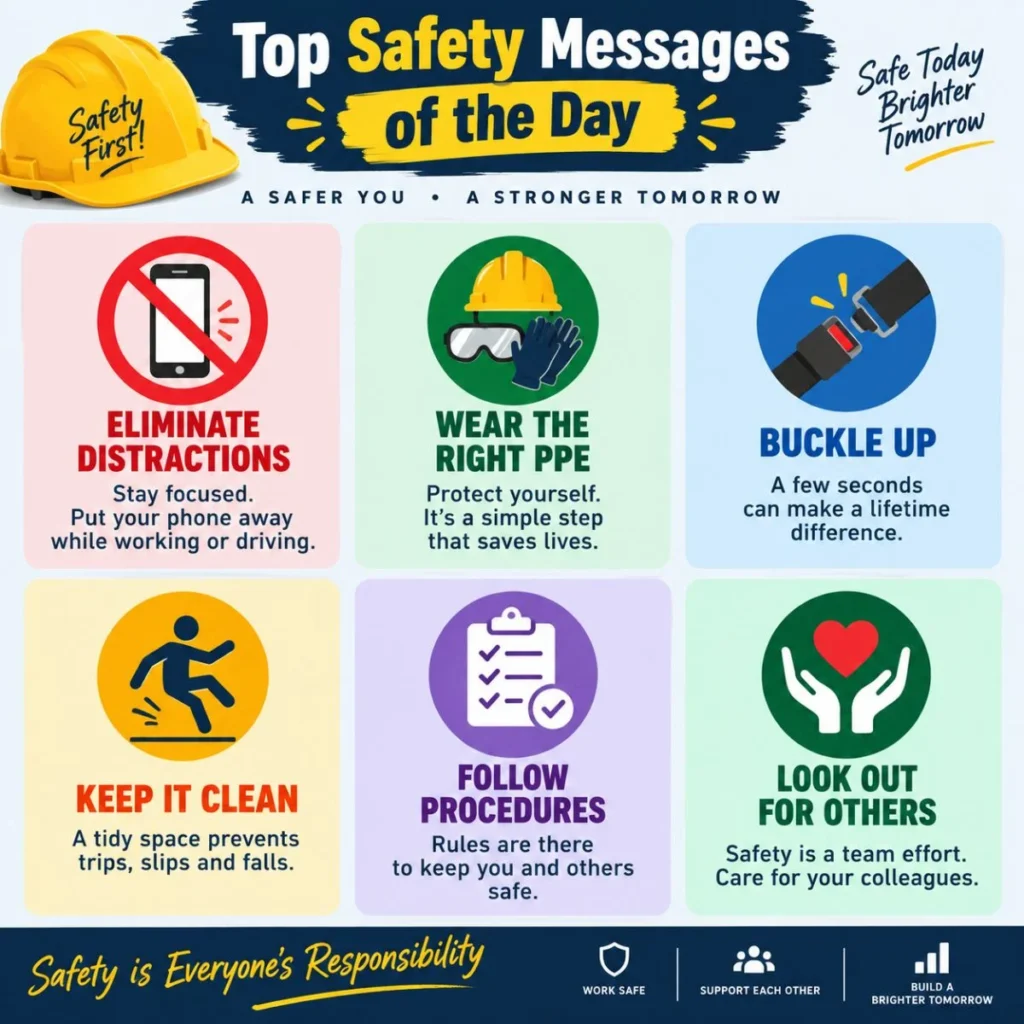
A good daily safety message doesn’t need complicated language. It simply points attention toward one safe behavior that matters right now. These messages work well for morning meetings, workplace announcements, school reminders, group chats, or personal motivation.
- Safety starts with one simple choice: pause, think, and act carefully.
- Take the extra moment to do it safely. A few seconds can prevent a serious mistake.
- Don’t let familiarity make you careless. Stay alert, even when the task feels routine.
- Your safety matters today, tomorrow, and every day after.
- Think before you act, especially when you’re tired, rushed, or distracted.
- A safe day begins with awareness and ends with everyone going home safely.
- Never trade safety for speed. The job can wait; your well-being cannot.
- Look around, stay aware, and never assume everything is safe just because it looks familiar.
- The safest choice is often the one that takes an extra minute.
- Pay attention to the little things. Small hazards can lead to big consequences.
- Protect yourself, look out for others, and speak up when something doesn’t seem right.
- Safety isn’t about being afraid; it’s about being prepared.
- Before starting any task, know what could go wrong and how you’ll prevent it.
- Stay focused on the task in front of you. Distraction can turn an easy job into a dangerous one.
- A strong safety culture begins when people care enough to remind one another.
- Don’t ignore a warning sign just because nothing has gone wrong yet.
- Make safety part of the plan, not something you think about afterward.
- When in doubt, stop and ask. A question is better than an avoidable accident.
- Every safe decision is a step toward a healthier, happier day.
- Go home with the same health and energy you had when you arrived.
Short Safety Message of the Day
Sometimes you need a reminder that fits on a poster, text message, status update, or team notification. These short messages are easy to read and remember.
- Stay alert. Stay safe.
- Think first. Act safely.
- Safety is always worth the extra minute.
- Slow down and stay aware.
- Make safety your daily habit.
- Protect yourself and protect others.
- Don’t rush what matters.
- Safe choices save more than time.
- Keep your eyes open and your mind focused.
- Stop, think, and proceed safely.
- Your attention is your first line of defense.
- Don’t assume—check.
- Be careful today so you can enjoy tomorrow.
- Safety begins with awareness.
- Stay focused, even on familiar tasks.
- One careless moment can change everything.
- Choose caution over convenience.
- Look twice. Move once.
- Safe habits build safe days.
- Make today’s goal: everyone gets home safely.
Workplace Safety Messages
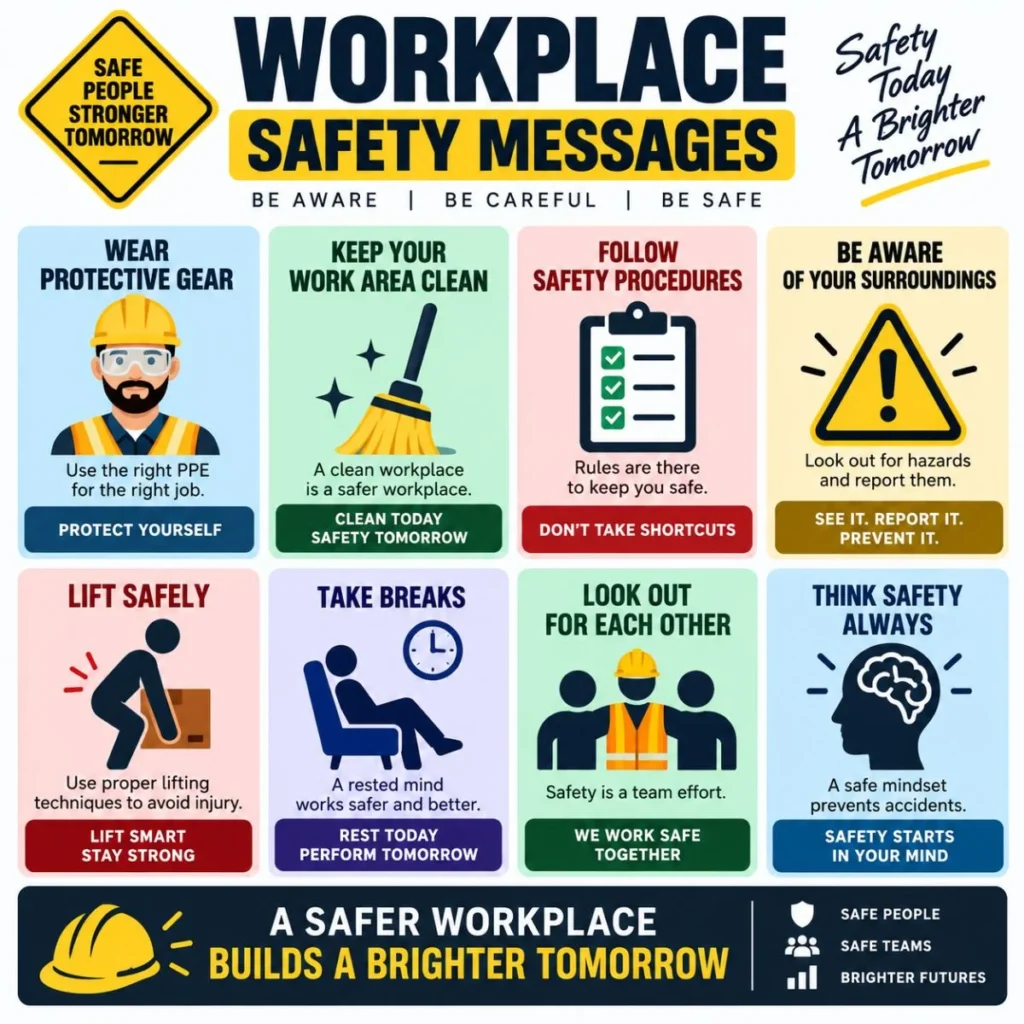
Workplace safety reminders are most effective when they connect with everyday behavior. Whether the setting is an office, warehouse, construction site, laboratory, factory, hospital, retail store, or classroom, the message should encourage people to notice hazards and take responsibility for their own safety and the safety of others.
- Start every shift by checking your work area for hazards.
- Use the right tool for the job instead of finding a risky shortcut.
- Keep walkways clear. A clean path is a safer path.
- Wear required protective equipment correctly, even when the task seems quick.
- Never operate equipment unless you understand how to use it safely.
- Report hazards early instead of waiting for someone to get hurt.
- Don’t allow pressure to finish quickly to override safe procedures.
- If you see an unsafe condition, don’t walk past it without taking appropriate action.
- Keep your workspace organized so you can work without unnecessary obstacles.
- Follow established procedures, especially when handling equipment or hazardous materials.
- Take fatigue seriously. A tired worker may not notice hazards as quickly as a rested one.
- Communication is part of safety. Make sure the people around you know what is happening.
- Before lifting, ask yourself whether the load is within your ability and whether you need help.
- Keep emergency exits accessible and know where they are located.
- Never assume someone else has reported a dangerous condition.
- Use safety equipment for every task where it is required, not only when supervisors are watching.
- If a procedure seems unsafe, stop and raise the concern rather than improvising.
- Respect warning signs, barriers, labels, and instructions.
- A productive workplace is one where people can perform well without unnecessary risk.
- The best safety meeting is the one that changes what someone does afterward.
Daily Safety Messages for Employees
Employees often respond better to reminders that feel respectful rather than threatening. These messages focus on personal responsibility, teamwork, and the idea that safety belongs to everyone.
- Your experience is valuable, but experience should never replace attention.
- Look after yourself and the teammate working beside you.
- If you’re unsure, ask for guidance before continuing.
- Don’t be embarrassed to speak up about a safety concern.
- Take your breaks seriously so you can return to work focused.
- Use safe procedures even when you’re working alone.
- Don’t let a busy schedule push you into taking unnecessary risks.
- Before beginning a new task, make sure you understand the hazards involved.
- Your family expects you home safely—make that part of every workday.
- Encourage safe behavior without blaming or embarrassing others.
- If something changes during a task, pause and reassess the situation.
- Never ignore an injury just because it seems minor.
- Keep your attention on moving equipment, vehicles, tools, and other hazards around you.
- A safe teammate doesn’t just protect themselves; they help create a safer team.
- Respect your limits and ask for assistance when the task requires it.
- Safety isn’t only the supervisor’s responsibility. Everyone has a role.
- If you notice a near miss, treat it as a warning and learn from it.
- Take pride in doing the job correctly and safely.
- Don’t let yesterday’s accident-free day create today’s false confidence.
- Finish your shift safely—not just quickly.
Driving and Road Safety Messages
Driving safety is about making good decisions before and during a journey. A reminder can encourage people to slow down, avoid distractions, wear seat belts, maintain awareness, and never drive when they are not fit to do so.
- Buckle your seat belt before the vehicle moves.
- Put the phone away and give the road your full attention.
- Speeding can save minutes while creating consequences that last much longer.
- Leave enough space between your vehicle and the one ahead.
- Don’t drive when you’re too tired to stay fully alert.
- Slow down when road, weather, or traffic conditions change.
- Check your surroundings before changing lanes or making a turn.
- Don’t let an urgent message become a dangerous distraction.
- Arrive safely rather than trying to arrive quickly.
- Be patient with other drivers; everyone makes mistakes.
- Keep your eyes on the road, not on your screen.
- Before a long trip, make sure the vehicle is ready for the journey.
- Never let anger behind the wheel control your decisions.
- Give pedestrians and cyclists the attention and space they need.
- If you need to make a call or send a message, stop somewhere safe first.
- Watch for changing traffic conditions instead of relying only on what happened a moment ago.
- A defensive driver expects that other road users may make unexpected moves.
- Keep your hands, eyes, and attention where they belong.
- Don’t drive under the influence of alcohol or drugs.
- The most important destination is home safely.
Home Safety Messages
Home should feel comfortable, but everyday household activities can still involve risks. These reminders can be shared with family members or used as simple daily prompts around the house.
- Keep floors and stairs clear of unnecessary clutter.
- Check that appliances are being used according to their instructions.
- Keep anything that could harm a child safely out of reach.
- Don’t leave cooking unattended when you step away.
- Make sure smoke and carbon monoxide alarms are maintained and working as appropriate for your home.
- Keep emergency numbers and essential information easy to find.
- Store cleaning products and chemicals safely.
- Never ignore a strange smell, unusual sound, or other sign that something may be wrong.
- Keep electrical cords and outlets in good condition.
- Use a sturdy step ladder instead of standing on furniture.
- Close doors and windows securely when appropriate.
- Teach children simple safety habits through calm, repeated reminders.
- Keep pathways well lit, especially around stairs and entrances.
- Know where your home’s emergency supplies are kept.
- A few minutes of preparation can make an emergency easier to manage.
- Don’t overload electrical outlets or use damaged electrical equipment.
- Keep potentially dangerous tools away from children and unauthorized users.
- Make sure everyone in the household knows basic emergency procedures.
- Don’t take familiar household risks for granted.
- A safe home is built from small habits practiced consistently.
Safety Messages for Friends and Family
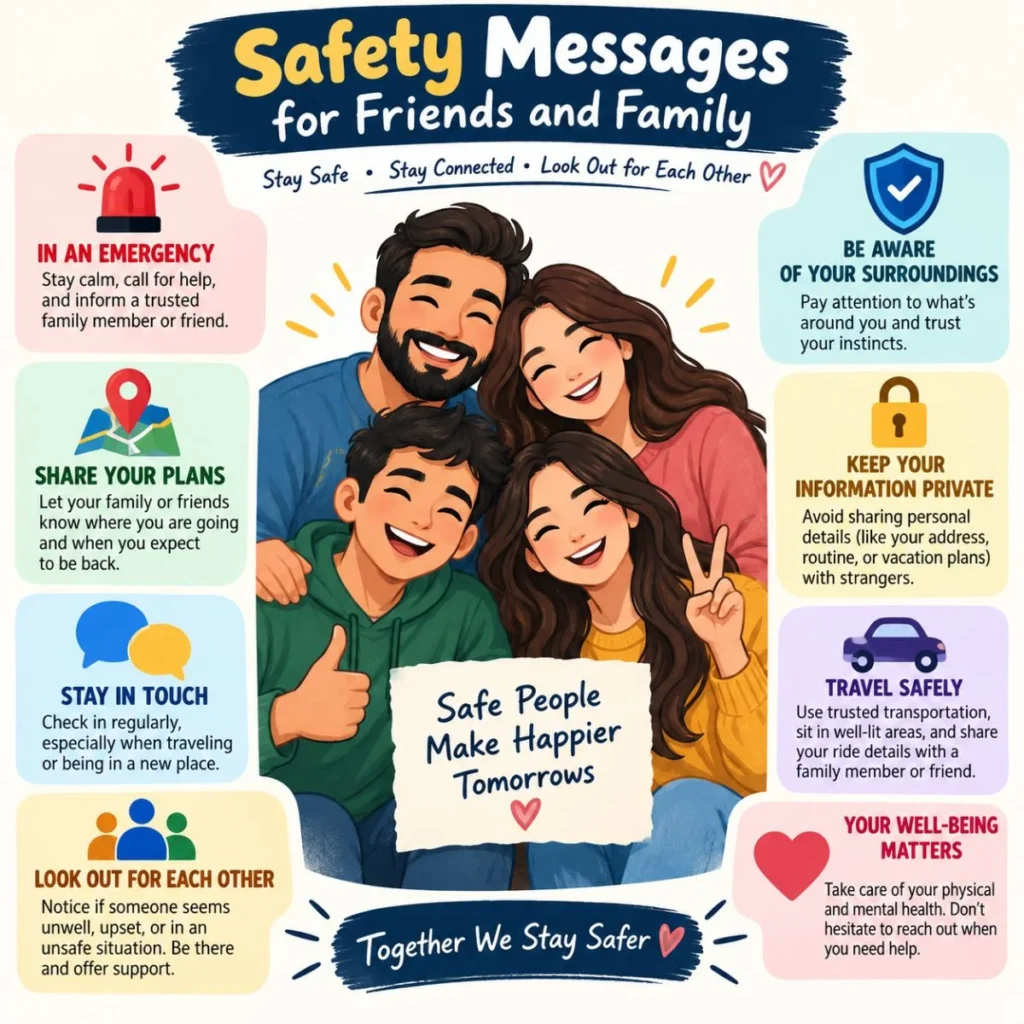
Safety reminders don’t have to sound formal. When you’re sending one to someone you care about, warmth can make the message feel more genuine.
- Take care of yourself today. I want to see you home safe and smiling.
- Whatever you’re doing today, don’t forget to look after yourself.
- Please don’t rush—your safety matters more than getting there a little faster.
- Stay aware, trust your instincts, and take care of yourself.
- Have a great day, but make sure you make it a safe one too.
- Wherever you go today, keep your eyes open and your phone down when you need to focus.
- Be careful out there. Someone who loves you is waiting to hear that you arrived safely.
- Don’t ignore the little warning signs. Take care of yourself before a problem becomes bigger.
- Work hard, enjoy your day, and remember to come home safely.
- If something doesn’t feel right, pause and give yourself time to think.
- Your health and safety are more important than finishing something in a hurry.
- Take the safe route whenever you can.
- Promise me you’ll be careful today. ❤️
- Stay safe, stay alert, and don’t forget to take a breath when the day gets hectic.
- You don’t have to prove anything by taking unnecessary risks.
- Look after yourself the way you’d look after someone you love.
- Wherever today takes you, make safety part of the journey.
- Be smart, be careful, and come back with a good story—not an avoidable injury.
- I hope your day is productive, peaceful, and completely safe.
- Take care of yourself today. You matter more than you realize.
Deep and Meaningful Safety Messages
A meaningful safety reminder can go beyond rules. These messages focus on why safe choices matter and encourage people to think about the people and plans waiting for them beyond the immediate moment.
- A moment of caution can protect years of memories.
- Safety is not about slowing life down; it’s about giving yourself the chance to keep living it.
- Someone is waiting for you at the end of the day, so don’t let a shortcut decide your future.
- The task may be important, but the person doing it is more important.
- We cannot control every risk, but we can control many of the choices we make around risk.
- A near miss is not proof that a dangerous action was harmless; it’s an opportunity to learn.
- Courage isn’t ignoring danger. Sometimes courage means stopping and asking for help.
- The people who depend on you need your success, but they also need you safe.
- Don’t measure a successful day only by what you accomplished. Measure it by whether you protected yourself along the way.
- A safety rule may seem inconvenient until the day you realize why it exists.
- Every safe habit becomes part of the environment we create for everyone around us.
- The goal isn’t simply to avoid accidents; it’s to build habits that make safer choices natural.
- When people care about one another, safety becomes more than a policy—it becomes a shared responsibility.
- Your future self will be grateful for the careful decision you make today.
- Never be so focused on the destination that you stop paying attention to the journey.
- Safety is an everyday expression of respect—for yourself, your family, and the people around you.
- A small pause can create the space needed for a much better decision.
- The safest person isn’t the one who never faces risk, but the one who recognizes it and responds wisely.
- Protect the life you’re building by taking care of the person who is building it.
- Go home safely. The best part of the day may still be waiting for you there.
One-Line Safety Messages for Status and Social Media
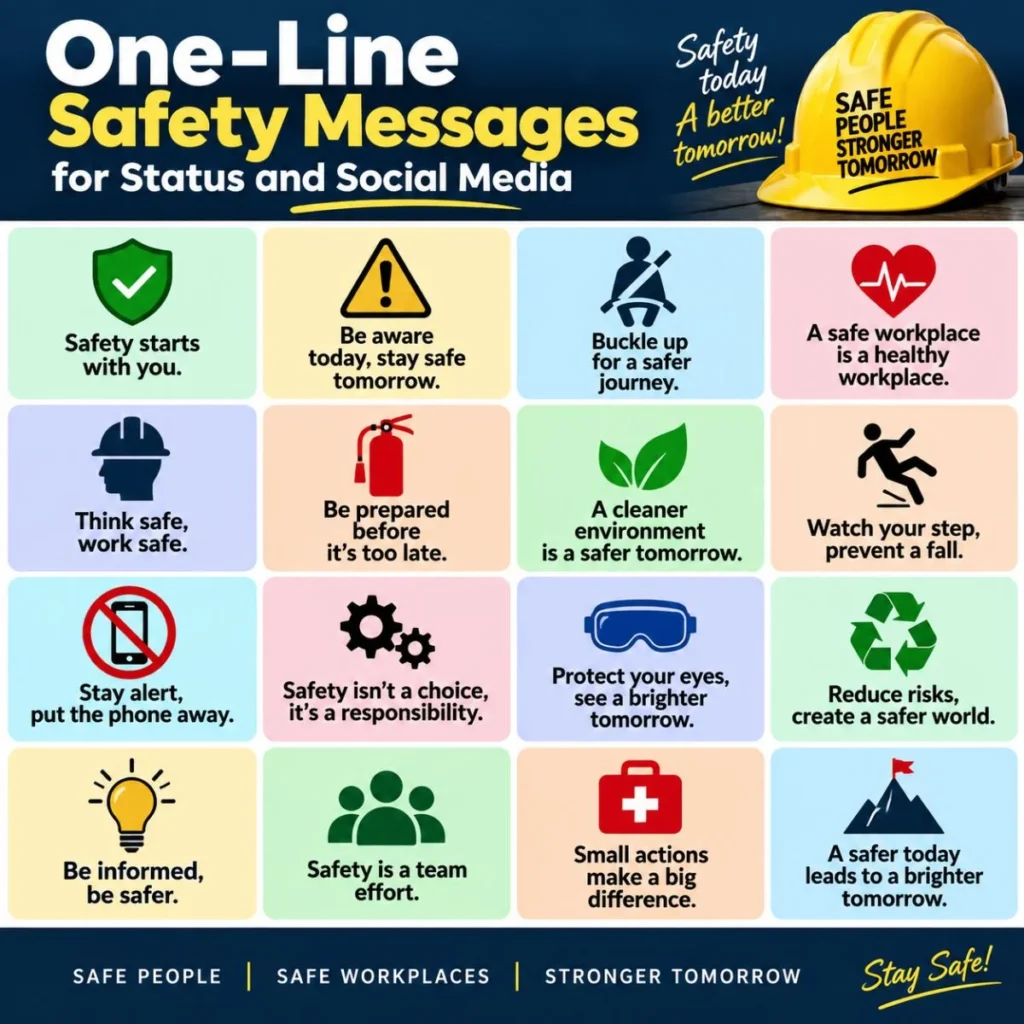
If you want something short for a social media status, workplace board, group announcement, or daily post, these one-liners are easy to share without needing additional explanation.
- Safety isn’t a task on the list; it’s the way we approach every task.
- Make caution a habit, not a reaction.
- Stay aware today; thank yourself tomorrow.
- Safe habits are small investments in a better future.
- Don’t rush a decision that deserves your attention.
- Your attention can be more powerful than your equipment.
- A safer choice is rarely a wasted choice.
- Think twice when one mistake could matter for years.
- Keep safety close, especially when the day gets busy.
- Protect what matters by paying attention to what you’re doing.
- The smartest shortcut is the one that avoids an accident.
- Be responsible for the safety you can influence.
- Pause before the risk becomes a problem.
- Make every move with purpose and awareness.
- Safety is everyone’s business.
- Care today. Return home tomorrow.
- Don’t let confidence become carelessness.
- Stay prepared so small problems don’t become big emergencies.
- Safe decisions are worth repeating.
- Make today a day worth coming home from safely.
Safety Messages for Students and Young People
Students face their own everyday safety situations, from crossing roads and using equipment to managing distractions and looking after one another. These reminders keep the language simple and encouraging.
- Pay attention in places where traffic, equipment, or crowds can create hazards.
- Don’t let your phone distract you while walking near roads or stairs.
- Follow instructions when using laboratory, workshop, sports, or school equipment.
- If you see something dangerous, tell a teacher or responsible adult.
- Look out for your friends without putting yourself in danger.
- Don’t take unnecessary risks just because other people are doing it.
- Ask questions when you don’t understand a safety instruction.
- Keep hallways, stairs, and shared spaces clear.
- Wear the protective equipment required for activities and sports.
- Think about the consequences before turning a joke into a risky situation.
How to Choose the Right Safety Message
The best message depends on who will receive it and what they are doing. A workplace team may need a reminder about equipment or fatigue, while a family group may respond better to a warm message about getting home safely.
Consider these factors:
Think about the situation. A driving reminder makes sense before a road trip, while a lifting reminder is more appropriate in a warehouse or workplace.
Match the tone. Use professional language for employees and formal announcements. Use warmer language when sending a personal reminder to someone you care about.
Keep one main idea. A daily message becomes easier to remember when it focuses on one behavior instead of trying to cover every possible safety rule.
Make it actionable. “Be safe” is positive, but “Put your phone away before you start driving” gives someone a clear action.
Avoid fear-based language. A strong reminder can be serious without being dramatic. The purpose is to encourage safer behavior, not create unnecessary anxiety.
How to Personalize a Safety Message of the Day
A generic reminder becomes more meaningful when it reflects the person’s actual day. You don’t need to rewrite the entire message. One small detail can make it feel personal.
If anything feels unclear, let’s stop and check before moving ahead.”
You can personalize messages by mentioning:
- The specific task or activity happening that day
- A recent safety lesson or reminder
- Weather or travel conditions when relevant
- A person’s role or responsibility
- A shared goal, such as everyone returning home safely
- A simple expression of care
The key is to sound like a real person, not a printed warning label.
When to Send a Daily Safety Reminder
A safety message can be useful at the beginning of a shift, before a specific activity, during a team briefing, or whenever circumstances change.
For workplaces, morning meetings or shift-start briefings can provide a natural opportunity. For families, a quick message before a long drive or busy day may be more appropriate. Schools and organizations can use short reminders on notice boards, newsletters, announcements, or group communication channels.
The timing should support the behavior you’re encouraging. A driving reminder is most useful before someone starts driving, while a workplace equipment reminder makes sense before the equipment is used.
Avoid sending so many reminders that people stop noticing them. A focused, relevant message is usually more useful than a constant stream of generic warnings.
Tips for Making Safety Messages More Meaningful
A safety message doesn’t need to be dramatic to be memorable. In many cases, simple language works best.
Be specific. Tell people what to do rather than only telling them to “be careful.”
Use everyday language. People are more likely to connect with a message they would actually say themselves.
Focus on prevention. Encourage people to identify hazards and make safer choices before something goes wrong.
Respect the reader. Avoid talking down to adults or making people feel ashamed for asking questions.
Connect safety with something people value. Health, family, teammates, personal goals, and future plans can make a reminder more meaningful.
Change the focus regularly. Rotate between awareness, equipment, communication, fatigue, driving, housekeeping, emergency readiness, and other relevant topics.
Keep it brief. A daily reminder should reinforce safe behavior, not replace proper training, procedures, or professional guidance.
Frequently Asked Questions
What is a safety message of the day?
A safety message of the day is a short reminder designed to encourage safer behavior or awareness during everyday activities. It can be used at work, school, home, on the road, or in community settings.
What makes a good daily safety message?
A good message is clear, relevant, practical, and easy to remember. It should encourage a specific safe behavior or help people recognize a potential hazard without using unnecessary fear or complicated language.
Can I use these safety messages at work?
Yes. Many of these messages are suitable for workplace meetings, safety briefings, newsletters, team chats, posters, and employee communications. For specific hazards, however, workplace messages should also follow your organization’s safety policies and applicable requirements.
How long should a safety message be?
There is no fixed length. For a daily reminder, one or two sentences are often enough. The important thing is that the message is relevant and gives the reader something useful to remember or do.
Can I send a safety message to a friend or family member?
Absolutely. Personal safety messages can be warm and caring rather than formal. A simple reminder to drive carefully, stay alert, or take care of themselves can show someone that you care.
Should safety messages be serious all the time?
Not necessarily. A safety message can be positive, encouraging, thoughtful, or even lightly humorous when the situation allows. The important thing is that the tone doesn’t distract from the safety point or make a serious hazard seem unimportant.
Conclusion
A safety reminder doesn’t have to be long to matter. Sometimes the most useful message is a simple sentence that makes someone pause before taking a risk, check their surroundings, put on the right protective equipment, put away their phone, ask for help, or slow down.
The best safety message of the day is one that fits the people receiving it and the situation they’re facing. A workplace team may need a practical reminder about attention and procedures. A driver may need encouragement to put distractions aside. A friend may simply need to hear, “Please take care of yourself and come home safely.”
Use these messages as ready-to-share reminders, but don’t be afraid to personalize them. Add someone’s name, mention the day’s activity, or connect the message to something meaningful. That small personal touch can turn an ordinary safety reminder into something people actually remember.
Most importantly, safety isn’t created by one message. It’s built through repeated choices, honest communication, preparation, and people looking out for one another. Share the reminder, practice the habit, and encourage others to do the same.
A successful day isn’t just one where everything gets done. It’s one where everyone gets home safely.

Muhammad Sarfraz is a content creator and author at Message Ideas Daily, passionate about creating heartfelt, practical, and meaningful message ideas that help people express their feelings and connect with others.